The Formula to Achieve Universal Health Coverage
Today is Universal Health Coverage (UHC) day, a day to raise awareness about the need for strong and resilient health systems and the ability of everyone everywhere to access the quality health care they need. Worryingly, the world is nowhere near on track to achieve the United Nations’ global target of UHC by 2030—specifically, that all people have access to the full range of quality health services, when and where they need them, without financial hardship. According to the World Health Organization (WHO), improvements to health services coverage have stagnated since 2015, and over the last 20 years, financial protection has progressively deteriorated, with 2 billion people experiencing financial hardship and 1.3 billion people pushed into poverty due to health spending.
At mothers2mothers (m2m), we know all too well the tremendous amount of work and global commitment that lies ahead to meet this target—with over half of the population on the African continent unable to access health care and the region’s critically under-resourced health systems in need of an estimated 6.1 million more health care workers by 2030. But we also know that healthier populations build communities that are more resilient, productive, peaceful, and prosperous. With UHC, mothers would not miss out on the life-saving interventions they need for themselves or their children, people would be diagnosed and treated early.
PHC + CHW = UHC
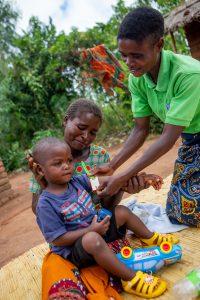
So how are we going to achieve health for all in Africa and around the globe? There is a growing global consensus that integrated primary health care (PHC), delivered by paid, trained, and professional community health workers (CHW), can deliver UHC—or, as m2m likes to say, PHC + CHW = UHC.
Why will this work?
- Integrated PHC is a community-centred approach that provides people with a one-stop shop for the health services they need throughout their lives. PHC also addresses broader determinants of health, and empowers individuals, families, and communities to take charge of their own health.
- CHWs, like m2m Mentor Mothers, are key drivers of PHC because of their shared lived experiences and deep understanding of the health needs of the communities they serve. Often CHWs have experienced similar health challenges as their clients which enable them to gain their trust and help them overcome barriers to accessing health services, and keep them in care for the long term. Furthermore, CHWs can be trained faster at a fraction of the cost as other health professionals, thus putting them in a unique position to meet urgent health needs. Investing in CHWs also makes business sense: an international study suggests that each $1 invested in CHW programmes delivers a $10 social and economic return.
- WHO estimates that most essential UHC interventions can be delivered through a PHC approach, potentially saving 60 million lives and increasing average global life expectancy by 2.7 years by 2030.
Ruth’s story—UHC at play
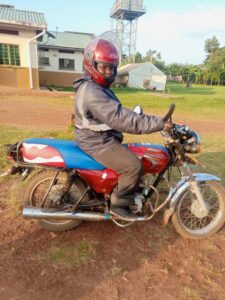
To understand why this approach is so effective, meet Ruth—a community health worker in Uganda employed by m2m as a Community Mentor Mother Coordinator—who makes quite an impression as the only woman who rides a motorbike through her community. This enables her to cover 13 to 20 kilometres (8-12 miles) every day, reaching families who have limited access to health care with essential health services and information.
It was on one of these trips that community members told her about a family whose children—ages five and three—were very sick, but the father would not take them to the health centre because of his beliefs in traditional medicine. Ruth enlisted the support of the village head and local leadership to convince the father to meet with her. “I introduced myself, asked for permission to talk, and assured him I wasn’t trying to criticise traditional medicine. I explained the benefits of healthcare check-ups, the risks of not going to the health facility, and why getting help from both traditional and modern medicine can be beneficial,” Ruth says.
Fortunately, Ruth was successful. The father agreed to bring his children to the health centre where they were diagnosed with malaria. Instead of becoming part of the devastating statistic—which sees children under age five accounting for about 80% of all malaria deaths in sub-Saharan Africa—they were put on treatment and are now healthy. Ruth also referred the children for their immunisations, and linked the parents to HIV testing, which came back negative.
Ruth remains in contact with the family to ensure they stay in care over the long term. Having seen how beneficial health services were to his children, the father now takes them to the health centre when they are unwell, and he recently invited Ruth to visit him and his wife. The reason? His wife is pregnant and he wanted to make sure she received proper care and good nutrition for a healthy pregnancy. Ruth educated both husband and wife on the importance of antenatal care, and connected them with an m2m Mentor Mother at the health facility to ensure she gets the care they need.
Ruth says people in the community are amazed. “They started asking me, that home was difficult, what did you do to start visiting that home? I see there is appreciation in the community that mothers2mothers has done great work,” she says.