Closing the Immunisation Gap
For decades, vaccines have stood as one of the greatest public health success stories—silently saving millions of lives each year. Smallpox was eradicated in 1980. Polio is nearly gone. These triumphs show us that immunisation for all is not just a dream—it’s a promise we can keep. But for millions of people in marginalised communities, that promise is under threat.
 This is the backdrop to the World Health Organization’s (WHO) 2025 World Immunisation Week, aptly themed ‘Immunisation for All is Humanly Possible’.
And now, with drastic foreign cuts, and the termination of the majority of United States Agency for International Development (USAID) and State Department foreign aid awards threatening vaccine management supply programmes, these hard-won gains are at risk. If resources dry up, health facilities and mobile outreach initiatives could run empty, people may go unvaccinated, and diseases we thought were gone could come roaring back.
According to the WHO, in 2023 alone, an estimated 14.5 million children around the world received zero vaccines—a number that’s more than a statistic. It’s a warning. Every child left unprotected is at risk of deadly, preventable diseases like measles, diphtheria, and polio. Measles, despite a proven vaccine, continues to claim young lives: in 2023, more than 22 million children missed their first dose, and 12 million didn’t receive their second.
In Malawi, these numbers are more than global trends—they reflect everyday realities. It can be a struggle to get to the health facilities due to the long distances, lack of transport, medicine stockouts, and deeply rooted social and gender barriers. That’s where mothers2mothers (m2m) comes in.
With support from Pfizer, m2m is strengthening primary healthcare in Lilongwe, Malawi. Our work is focused on increasing access to vaccinations for children, adolescents, and adults by supporting the Ministry of Health’s Community Health Strategy. We train community health workers (CHWs), deliver health education, conduct outreach services, and us digital tools to boost vaccine uptake and prevent needless deaths—through the hands and hearts of trusted, trained community health workers who walk door-to-door, educating families, dispelling myths, and connecting people like Favour to life-saving services.
Favour’s Story, and a Fight We Can’t Afford to Lose
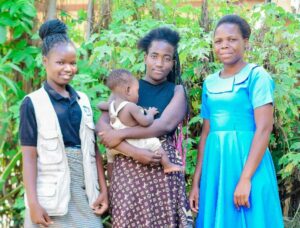
Favour, a 16-year-old mother from Mitundu in Lilongwe, Malawi, gave birth to her daughter Mercy in February 2024. Like many adolescent girls, Favour’s pregnancy forced her to prematurely leave school, and her journey into motherhood was filled with fear and isolation. She was alone and had no support from her partner or her immediate family.
Favour deeply loves her daughter, but she didn’t understand the importance of immunisation. After just three visits to the under-five clinic, she stopped going—uncertain, overwhelmed, and without anyone to guide her.
That changed when m2m Adolescent Peer Mentor Mother, Stivious, and Nutrition Facilitator, Rhoda, visited her home. They listened to her, spoke with her about the benefits of vaccines and proper nutrition, and helped her imagine a healthier future for Mercy. But when they followed up, Favour still hadn’t returned to the clinic.
Recognising the deeper challenges Favour faced, Rhoda and the local Health Surveillance Assistant (HSA) visited her again—offering support and addressing the fears Favour had that left her feeling unsure. This time, she felt ready.
“I am grateful that Stivious and Rhoda was so persistent. I didn’t realise that I was putting my child at risk,” Favour shared. “They referred me to the HSA who is very understanding and helps to explain health issues that I don’t understand.”
Today, Favour ensures Mercy gets all her vaccines on time. She’s back at the under-five clinic regularly and is closely supported by the HSA and the m2m team. Fortunately, Mercy attained her milestones in time without delay. Her story is one of hope, but also a powerful reminder of how fragile progress can be.
Progress Under Threat
In Malawi, the health system is still recovering from multiple public health emergencies, including a Wild Polio Virus outbreak, a protracted cholera crisis, and the COVID-19 pandemic. Gender inequities and social barriers continue to shape vaccine access. Many adolescent mothers, like Favour, face limited decision-making power, low literacy, and cultural norms that require male authorisation to seek care. Meanwhile, men are often not included in immunisation education, making it harder for women to secure consent for their children’s care.
The evidence is clear: vaccines work, and they save lives. But the road to universal immunisation requires more than syringes and schedules. It requires trust. It requires education. It requires women like Stivious and Rhoda—meeting families where they are, listening without judgement, and showing up again and again.
This World Immunisation Week let’s renew our commitment to leaving no child behind. Sign up to our newsletter today to learn more.