Six months on: the fallout of the devastating global aid cuts.
Today marks six months since drastic aid cuts dramatically changed the lives of mothers2mothers’ (m2m) community health workers and clients overnight. In January 2025, the United States (U.S.) government abruptly froze all its foreign aid funding, with immediate effect. A few days later, a “stop work order” was issued, preventing all health workers on USAID-funded programmes from reporting to work—a few weeks later, it was confirmed that 83% of all grants had been terminated.
For m2m Mentor Mothers—the local women living with HIV trained and employed as m2m community health workers—working across USAID-funded projects in South Africa, Lesotho, and Zambia, this came as complete shock and created an atmosphere of profound uncertainty. What did this actually mean? Why was it happening? How long would it last for? Wasn’t their work clearly essential and life-saving?
What’s been happening?
Six months on, the situation on the ground remains hugely challenging and uncertain, and for m2m, much of our own progress remains at risk. Six projects in South Africa, Lesotho, and Zambia where m2m delivered services funded by the U.S. government have been shuttered. As a result of this, and other necessary operational changes, we estimate we will reach nearly 500,000 fewer people in 2025 than we did in 2024—meaning they will miss out on life-saving health services they had come to rely on m2m for. Over 500 community health workers employed by m2m have lost their jobs since January—and many were the primary breadwinners in their families.

This devastating U.S. funding cut is part of a growing and worrying global retreat from overseas development aid. At least five countries, including the U.S., which together provide more than 90% of global funding to fight HIV, are also implementing significant cuts to foreign aid. The consequences are already dire: UNAIDS estimates there will be 6 million more new infections and 4 million AIDS-related deaths by 2029, if US-supported HIV treatment and prevention services collapse entirely. Earlier this month, another study found that more than 14 million people could die over the next five years because of the dismantling of USAID.
What is the reality on the ground?
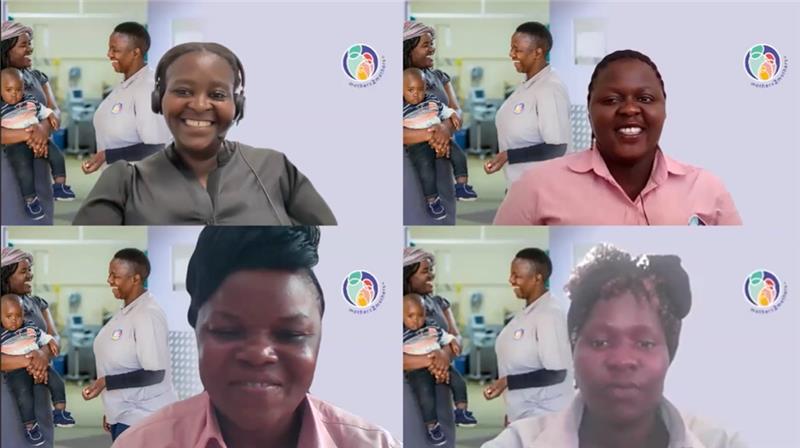
Behind each of these numbers are human stories. So, we decided to ask Layla*, a Nurse working for the Zambian Ministry of Health, what the impact of the cuts has been from her perspective. In Zambia, we had to pause services for almost five months in many areas before we were—happily—able to partially restore funding and resume work. Layla’s testimony is a first-hand look at what it meant when Mentor Mothers were absent, what it means to have them back, and how the broader health system is faring.
Health facilities are overwhelmed
Mentor Mothers relieve the burden on doctors and nurses at understaffed health centres, allowing these clinicians to focus on using their skills for the greatest impact. But with less support from non-governmental organisations (NGOs) like m2m and community health workers that were running or collaborating on USAID-funded projects, staff at health facilities have become even more stretched and are struggling to meet patient needs.
“Mentor Mothers are of great support to us. They follow up with mothers and children who miss appointments, help conduct important tests, and promote treatment adherence.
But now, less people come to the facility, and some are afraid of approaching nurses. Community health workers like Mentor Mothers act as a bridge between us and the community. As members of their own community, clients feel welcome and safe talking to them. Without Mentor Mothers, that bridge is gone.”
Data entry and monitoring systems are also weakening. With less funding, there is less capacity to track and report on what’s happening, and more errors and mistakes being made—making it harder to respond quickly and effectively to ever-shifting health needs.
HIV testing and counselling have taken a hit
Mentor Mothers deliver support, education, and services that prevent new infections, promote adherence to treatment, and prevent mother-to-child transmission (MTCT) of HIV. As a result of their hard and impactful work, m2m Mentor Mothers achieved in 2023 what was once thought to be impossible: the virtual elimination of the transmission of HIV from mother to baby for our enrolled clients for 10 years in a a row, and an MTCT rate of 0% for enrolled m2m clients.
But with Mentor Mothers missing, decades of progress are at risk unravelling:
“People’s health is starting to be seriously impacted. Testing like dry blood spot and other HIV-related services have been disrupted because there is no one reminding clients to come in. Without Mentor Mothers at facilities, many HIV-exposed infants were missing their final outcome tests because their mothers are no longer getting the reminders and follow-up they need.”
As an organisation that was founded in 2001 to create a generation free from HIV, we cannot stand by and let decades of progress being reversed.
Wider community support programmes are falling apart
As community health workers lose their jobs, the community is also losing access to health education sessions on a whole range of health issues—both in health facilities and within communities, including at homes. Fewer people are receiving preventative counselling, and more are being diagnosed late, when it’s often too late for early intervention. Many psychosocial and adherence support programs have shut down entirely, leaving people without the help they need to stay on treatment and manage their health. Prevention is better (and cheaper) than cure…but it seems the lesson from this old saying is not being heeded.
What is more, without community outreach and awareness efforts, stigma is on the rise once again—discouraging many from getting tested or seeking care.
What if we stay on this current trajectory?
“If this situation continues for another six months, we may see a rise in mother-to-child transmission of HIV. Many clients may stop coming to the health facility altogether. An increase in infections for HIV, tuberculosis, and a rise in diabetes, hypertension, and cervical cancer could happen as more people stop taking their treatment properly. We could even see more maternal and newborn deaths.”
Where do we go from here?
This is not just about m2m. While we have worked hard to restore funding and services, and we can keep going (albeit with many challenges), many of our partner NGOs have had to shut down, and government services are under strain. We are seeing crowded clinics, overwhelmed staff, and fearful clients.
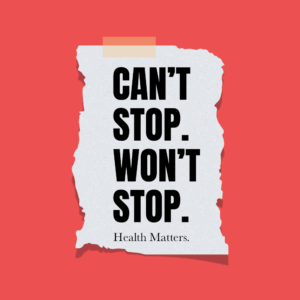
We need governments to step up, companies and philanthropists to help, and ordinary people to commit to keeping this issue in the spotlight. That’s why we have launched “Can’t Stop, Won’t Stop”, a campaign to highlight these challenges and propose solutions.
We are so close to ending AIDS and delivering health for all. We can’t stop now. So, we ask you—what will you do to step up?
*The name “Layla” has been changed to protect the contributor’s privacy.