Ending AIDS by 2030 IS Possible—But Will World Leaders Seize the Opportunity?
Today, UNAIDS released their flagship annual report, containing new data and an assessment of progress towards ending HIV/AIDS by 2030. The picture is mixed.
Remarkable progress has been made—for instance 39% fewer people acquired HIV in 2023 compared with 2010, with sub-Saharan Africa achieving the steepest reduction (−56%). Yet critical gaps remain, funding is at its lowest level in more than a decade, and—unless world leaders urgently rise to the challenge through investment, innovation, and intensified collaboration—we will miss a once-in-a-generation opportunity to end the HIV/AIDS pandemic for good.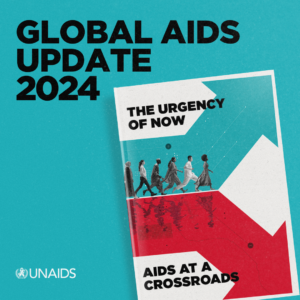
Here are some of the key findings and messages from the report relevant to mothers2mothers’ (m2m’s) work, and our view on them.
New Infections Have Declined In Children, But Progress Is Slowing and An Unacceptable Treatment Gap Remains
The report notes that: “Far fewer children aged 0–14 years are acquiring HIV, a trend that is due largely to successes in eastern and southern Africa, where the annual number of new HIV infections in children fell by 73% between 2010 and 2023. The overall decline in vertical HIV infections, however, has slowed markedly in recent years, particularly in western and central Africa. What is more, children are still the age group least likely to receive HIV treatment, and is markedly lower than among adults. Only approximately 65% of children living with HIV in eastern and southern Africa were receiving treatment, compared to 84% among adults.”
The outcome? “Children accounted for 12% of all AIDS-related deaths, even though they constitute only 3% of people living with HIV.”
At m2m, we’re committed to ending AIDS in children—and we know our peer- and community-led model is making a significant contribution. In 2023, we reported a 0% mother-to-child transmission rate for our enrolled clients and achieved virtual elimination for the tenth year in a row—showing what is possible when we invest in and support women as community health workers on an ongoing basis.
Delivering Integrated Health Services is Essential to End AIDS and Deliver Health For All
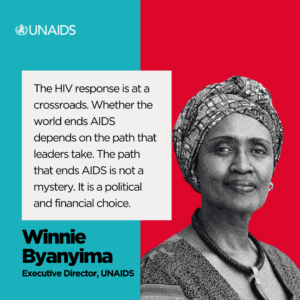 UNAIDS stresses: “When integrated, HIV and other health services can improve health outcomes, strengthen health systems, and support progress towards universal health coverage.”
We agree, and that’s why we now deliver an integrated set of primary health services to the communities we serve, using our peer-led model. In 2023, we met or surpassed UNAIDS’
ambitious 95-95-95 targets for HIV testing, treatment, and viral suppression for our enrolled clients, while also moving the needle on other critical health outcomes. For instance, 93% of our clients used modern family planning methods, compared to a benchmark of 56% in sub-Saharan Africa. And, 98% of our clients had received age-appropriate vaccinations by their first birthday—helping to safeguard their health.
We know that people-centric, context-specific, integrated health services are the path to end HIV, and we will continue to advocate for these, and to highlight the broader health benefits they bring.
Investment—Especially In Communities—Must Increase…and Fast
Investment is shrinking globally and insufficient resources are holding back progress. As UNAIDS notes, “total resources available for HIV are at their lowest level in over a decade” and “the continued underfunding of HIV prevention and community-led activities does not bode well for the HIV response”.
It feels like a cruel irony that resources are dwindling at the same time that proven approaches are available to scale. At m2m, we will continue to highlight the urgency of now, and the unique opportunity we have to end AIDS. We are committed to the communities we support across sub-Saharan Africa, and to creating new partnerships—from the private sector, and individuals, to multilaterals and trusts and foundations—so as to ensure we can continue to play our part in delivering an end to AIDS and realising health for all by 2030.