Fighting Malaria, One Family at a Time
Malaria remains one of the most devastating diseases affecting millions across Sub-Saharan Africa. It is a particularly dangerous threat for vulnerable groups such as children under five and pregnant women. Despite progress in prevention and treatment, malaria continues to claim lives and disrupt families.
According to the World Health Organization’s (WHO) latest 2024 World Malaria Report, there were an estimated 263 million cases and 597,000 malaria deaths globally in 2023. This is an increase of 11 million cases from the previous year. Alarmingly, 95% of these deaths occurred in Africa, where many communities still struggle to access essential healthcare services. Four of the countries where mothers2mothers (m2m) is operational, made the top five list of countries with the heaviest estimated burden of malaria in 2023— Nigeria (26%), the Democratic Republic of the Congo (13%), Uganda (5%), Ethiopia (4%) and Mozambique (4%).
For families in these malaria-prone areas, fighting the disease is more than a health challenge—it’s a fight for survival. At m2m, we are committed to breaking this cycle by integrating malaria prevention and treatment into our primary healthcare services. Our frontline health workers—local women living with HIV who are trained to provide health education and support to women, children, and entire families—are at the forefront of this effort.
A Father’s Fight Against Malaria
In Bubangi village, Uganda, Charles—a devoted father, faced a terrifying ordeal when his two-year-old daughter, Favour, fell gravely ill. Feverish and weak, she showed clear signs of malaria, but the family had not sought medical help—a common situation due to a lack of awareness or resources.

Community Mentor Mother—Joy Chematos, discovered Favour’s condition during a routine home visit in June 2024. Recognising the urgency, Joy acted swiftly, referring the family to a nearby clinic where Favour was diagnosed with malaria and immediately started treatment.
“One of the biggest challenges we see is that families often delay seeking treatment,” Joy explains. “By the time they realise the danger, it can be too late.”
Determined to ensure Favour’s full recovery, Joy followed up with the family just two days later. She was relieved to see the little girl improving. “I could see the difference in her condition, and it gave me hope,” she recalls.
But Joy’s support didn’t stop there. Over the following months, she continued visiting Charles and his family, providing guidance on malaria prevention. With her help, they made significant changes—consistent use of insecticide-treated mosquito nets, the construction of a clean latrine, and the addition of a rubbish pit to reduce mosquito breeding grounds. By the end of 2024, for the first time in years, the household reported zero cases of malaria for six consecutive months.
“The support we received from Joy changed our lives,” Charles shares. “She helped us chase malaria out of our home and taught us how to keep our family healthy.”
More Than Just Treatment—A Path to Change
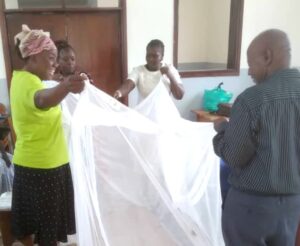
At m2m, we know that fighting malaria is about more than just treatment—it’s about equipping families with the knowledge and resources to protect themselves for the long term. By ensuring that families like Charles’ have access to timely treatment and education, we are taking meaningful steps toward a malaria-free future.
As Joy reflects, “Malaria is preventable and treatable, but only if families have the right support. That’s where Mentor Mothers come in. We don’t just identify and treat symptoms; we help families to live healthier lives.”